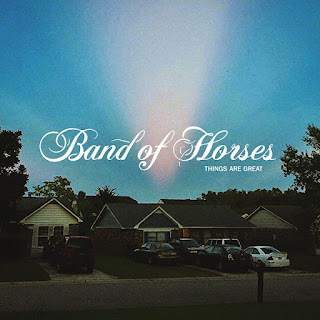
In Review: Band of Horses - "Things Are Great"


Ben Bridwell knows a thing or two about change. Things Are Great, Band of Horses' sixth studio album (and first in six years) sees the group on their fourth record label with their sixteenth band member; Bridwell is the sole original member remaining from their earliest incarnation as the fawned-over indie buzz band who first caught attention over fifteen years ago with their highly lauded debut Everything All the Time. An aching, earnest record full of heart and raw emotion, Everything All the Time is the blessing and the curse Bridwell has wrestled with for the entirety of Band of Horses' run; each subsequent album has been held up against that first record, criticisms unfairly painted with the same broad brush. As new sonic ground was explored (and new players brought on to facilitate exploration), the sign posts inevitably pointed back to 2006, for better or for worse.

Things Are Great is getting some of that slightly misleading "return to form" buzz, it's certainly warranted to an extent; some of those early vibes are indeed present, especially on opener Warning Signs, which cribs a fraction of the emotional intensity of The Funeral as it builds toward its conclusion. Elsewhere, there are some melodic widescreen moments, such as the lilting, heartbroken In the Hard Times, the subdued at first and boiling over at its end Aftermath, or the layered and hopeful closer Coalinga.

Perhaps the nostalgia Things Are Great is best at, however, is to some of Band of Horses' most memorable singles. The sunny, upbeat and harmonic styles employed on post-major label signing hits like Laredo and Knock Knock are somewhat of a connective tissue on the album, as is most effectively conveyed by the jangly, peppy lead single Crutch, maybe the bounciest single they've put out to date (and, wouldn't you know it, Crutch is the first #1 they've ever had on radio). The other two lead-in singles, In Need of Repair and Lights, carry the same laid-back and supremely harmonic tendencies, while late album cut Ice Night We're Having is practically punk by BoH standards.

That covers the majority of the album and, though there isn't much in the way of sonic deviation, there is room for a couple of side steps; Tragedy of the Commons lends itself to the more melancholic moods that permeated those early albums but is restless in scope and style, undergoing a few transitions along the way while coming back to its simple, effective chorus. You Are Nice To Me, meanwhile, incorporates some processed beats and added sonic clutter to obfuscate one of the album's sparsest overall songs.

That pair of songs, involuntarily as it may be, illustrate my biggest criticism of Things Are Great; they stand out on a track list that's mostly comprised of songs that strive for a return to the band's early days and/or middle of the road success. Now, there's nothing wrong with playing to your strengths, and Band of Horses are very strong at indie melancholy and big chorus melodies in equal measure; I admit that, as few chances as the album takes, this is still perhaps the Band of Horses album that's most pleasant to listen to. It just occurs to me that, as far as progression goes, they haven't really strayed all that far from where they started, despite all of the changes they've undergone.

March 4, 2022 • BMG
Highlights Crutch • Tragedy of the Commons • In the Hard Times

Comments

Popular posts from this blog

Year in Rock 2025

  Alright, I've got some explaining to do.   By now anyone who's visited this blog is well aware of how infrequently I've used this space in recent years; aside from the occasional fertile year of content, I really haven't posted all that often over the last five years or so. There are many reasons for this, which have already been outlined in previous apology posts; but, essentially, it boils down to my own laziness and the cold reality that blogs are, like Refused (again), fucking dead. So, I wouldn't hold my breath for a triumphant return to reviews, or even semi-regular posts, but:   a) I feel like Year in Rock posts have always belonged here and, even though I've experimented with different methods of presentation recently and been satisfied, the "blink and you missed it" unveiling via Facebook stories this year was perhaps ultimately a disservice to the records I lauded. After all, cramming the list into short videos isn't too far off from ju...

Year in Rock 2011 Nominee: Sam Roberts Band

SAM ROBERTS BAND I Feel You From: Collider Released: May 10 Having already endured the breakout success ( Brother Down was Canada's it rock song of 2002), the tentative dabbling in the U.S. market, as is the rite of passage for all moderately successful Canuck artists (2003's debut We Were Born in a Flame was the best time to try; one of the best albums of the year, it made a small dent in the American mindset upon its release there a year later), the difficult, druggy third album (the aptly named 2005 disc Chemical City ), and the subdued creative step backward (2008's Love at the End of the World , aside from hit single Them Kids , was really kinda bland), it seems according to script that Sam Roberts would start settling in on his fourth album (and first with the band credited as equal contributors), Collider (you know, I think it was a bad idea to give me brackets). Well, as far as settling in goes, Roberts does and doesn't on Collider .  W...

IN REVIEW: Rancid - "Trouble Maker"

As far as punk rock goes, it's hard to name a hotter hot streak than the trio of records Rancid cranked out between 1995 and 2000; the star making ...And Out Come the Wolves , the far-reaching Life Won't Wait and their balls-to-the-wall second self-titled album solidly positioned Rancid as leaders of the second generation of punk. It also preceded a period of slow progression, as Rancid would take eleven years to release their next three records. By the time ...Honor Is All We Know came in 2014, many fans (myself included) had to wonder whether or not this was the end of the road. Such concerns are handily dealt with on the closing track of the standard edition of their ninth record, the positively punishing This Is Not the End . Well, okay then, that's sorted. Now, what of this new record? What do we make of the use of their original logo on the cover, a logo that hasn't graced a Rancid record in 25 years? Is this a throwback to the band's heyday, a new begin...